
All Rights Reserved
© 2026 Psychē by Danielle.
© 2026 Psychē by Danielle.

Much of what we avoid is not failure, but our own power and the responsibility that comes with it. I can relate, I’ve done it myself.
Bringing our deeper visions to life asks something of us: to meet ourselves fully, to take responsibility for what we know, and to loosen our grip on the structures that once made us feel safe. Often, we hesitate not because we lack clarity or capability, but because following what feels true would threaten the very systems we’ve built our lives around.
Here lies the edge — where change feels terrifying and staying inside the comfort of the known is nothing short of seductive. Many of us, instead of honouring what’s asking for expression, learn how to adapt, endure, and make things work. We downplay our needs. We stay quiet. We trade aliveness for stability, and tell ourselves this is just a part of life that we have to deal with.
I know this terrain well.
Over time — as a therapist, mother, woman, and guide — I’ve become intimately familiar with the backroads of the psyche: the paths that look like shortcuts, but only ever take us in loops. I know what it’s like to ignore deeper longings, to keep the peace by packing parts of yourself away, as if they were things you could put in a drawer and return to later. I lived that way for a long time, until the version of stability I was protecting began to bankrupt my sense of self.
This is why I'm drawn to working withi self-led, discerning women. Women who are capable, intelligent, and deeply resourced — and who can feel when a way of living has been outgrown, even if it once made sense. By virtue of pursuing excellence, they’re often asked to navigate complexity and constant change. The movement they’re being invited into now is quieter, but no less significant: away from effort and performance, and toward a more rooted, honest way of being.
Much of my work meets clients at a horizon — the place where what has been known no longer holds, but what comes next has not yet taken form. It can be a beautiful and lonely place to stand. My role is not to rush this moment or to impose answers, but to meet you there with presence, discernment, and care.
I support you in reconnecting with, accepting, and becoming more of who you fundamentally are, so that your choices, standards, and direction arise from coherence rather than pressure. From this place, life begins to reorganise — not through force or reinvention, but through clarity, self-trust, and embodied truth.
Through this work, we walk deeper into the unseen — drawing from intuition, energy, and essence — remembering that it's not something to master or perform, but to lean into, honour, and work with. In trusting it, and ourselves, a steadier authority emerges.
This is the lens through which I live, work, and lead.
With warmth,
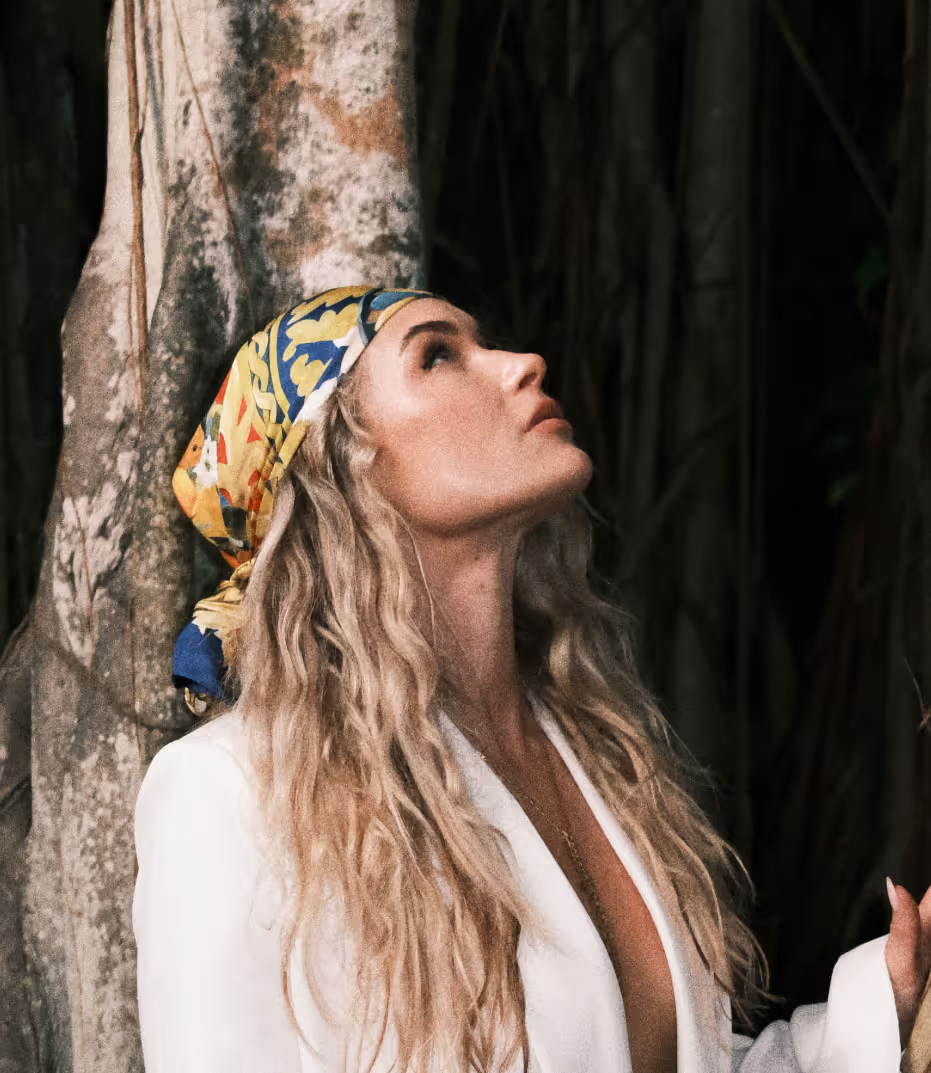
I’m a native Californian — deeply empathic, energetic, and thoughtful. A dreamer, and a proud mother of two. Those who know me best often say I carry both depth and lightness; that I notice the small things, and have a way of making people feel seen.
I come from a long line of cowboys, trailblazers, and spirited free-thinkers, and that same pull toward exploration is what eventually led me across the Atlantic, where I now call the UK home. My lineage gifted me a reverence for nature, an instinct to question boundaries, and the courage to step into the unknown. To me, everything holds meaning — every circumstance, every connection, every fleeting moment invites curiosity. I believe that if we're willing to have an ongoing dialogue with life, a certain vitality materialises — one that shapes not just how we live, but how deeply we experience being alive.
I’m a psychologist by training, and a mystic at heart. My sensitivity runs deep. Some might call it clairsentience; I think of it more simply as attunement — a felt sense of life and of others. Above all, I prize love: as lens, as practice, as the steady pulse beneath everything. I see the world through many prisms, endlessly curious about how our inner and outer realities are shaped. Few things fascinate me more than the conversation between psyche and body, and the intelligence that unfolds when we trust our own wisdom and move with intention.
The woman I am today was shaped early by a sensitivity to others — a natural instinct to notice, care, and hold what felt fragile. From the outside, my life appeared stable and successful. I did well academically, had close friendships, and moved through environments that looked supportive. Inside, though, I was learning something different: that love and safety were often conditional, and could be secured through performance, composure, and self-sacrifice.
So I became skilled at being what others needed me to be — capable, adaptable, easy to rely on. I learned how to excel, how to keep going, how to stay outwardly intact even when parts of me were struggling. It took many years before I understood the cost of that strategy, or had language for the ways I was abandoning myself in order to belong.
At sixteen, I left home believing freedom lived somewhere else. And for a time, it did. My life unfolded across cities and countries — Santa Barbara, Cambridge, Madrid, Ibiza, London — and I learned how to begin again, again, and again. I became adept at navigating new worlds, new identities, new expectations. But wherever I went, the same internal patterns followed: achieve, adapt, stay safe.
By my early thirties — immersed in my professional doctorate in counselling psychology, marriage, and motherhood — a relentless ache remained. On paper, I was doing everything “right.” In reality, I felt disillusioned and increasingly disconnected from myself. I sought answers through achievement, relationships, and healing modalities, before finally recognising what I was seeking was within all along.
The years that followed asked a great deal of me. They required me to reckon honestly with attachment, trauma, and the ways strength and softness had been falsely split within me. As a single mother rebuilding professionally and emotionally, I learned how to stand inside complexity without collapsing or hardening. I began to question inherited definitions of success, womanhood, and stability, and to choose a slower, more truthful way of living.
What I came to understand is this: growth is rarely linear. It is shaped through loss, repetition, and moments of choice. And it asks something simple, but exacting — that we stop trading parts of ourselves for love, safety, or approval.
My story reflects a pattern I see again and again in the clients I work with. Life may look full, even beautiful, on the surface, yet something essential is waiting to be reclaimed. Often, that moment arrives at a threshold: between who you’ve been and who you’re no longer willing to abandon.
There is no such thing as a genuinely "quick" fix, no matter how hard we try we can't bypass the human experience. Instead, I believe we must summon our courage to take the time it requires to brew truth. As we learn how to live from wholeness rather than performance, we allow life to reorganise from a new centre.
This is the path I’ve walked, and the one I now hold with others. Not a path of fixing or reinvention, but of remembering, and learning how to build a life that can finally hold you as fully as you’ve held everyone else.
How I See the Work
I approach this work with the understanding that while each client's life is uniquely her own, there are shared patterns that shape us all. We are meaning-making beings. We adapt in order to belong. And we are animated by emotional, relational, and unseen forces that often move beneath conscious awareness.
At the heart of my work is a humanistic understanding: that much of who we become is shaped by the relational, cultural, and emotional contexts we move through. Many of the strategies we carry were learned intelligently, in service of safety, belonging, or love. Each client is honoured as the authority of her own experience, with an innate capacity toward truth, growth, and natural evolution when the conditions are right.
My role is not to direct or prescribe, but to create those conditions — and to support the translation of inner truth into lived choice, direction, and change.
Presence as Method
My approach lives where psychology and soul converge. It is informed by psychotherapeutic training, relational and psychodynamic understanding, somatic intelligence, and intuitive awareness — not as techniques to be applied, but as lenses through which I attune more precisely.
Insight matters, but insight alone is rarely enough. Sustainable change happens when understanding is met with embodiment, and when the nervous system feels safe enough to reorganise — and when what becomes clear internally is allowed to shape how you live, decide, and lead externally.
Presence is the method here. Not as an idea, but as a lived, relational experience.
Over time, this quality of presence is internalised. Self-trust becomes less conceptual and more embodied. What once required effort begins to arrange itself more naturally from within.
A Developmental Pace
I work slowly enough for the body to trust, and deliberately enough for real integration to occur. Rather than pursuing outcomes or timelines, I work developmentally — responsive to where you are in your own unfolding, and to what is ready to be seen, felt, or released.
At times, this work looks like therapeutic depth: making sense of patterns, attachment, and nervous system responses. At others, it looks like clear-eyed guidance — supporting you to make decisions, set boundaries, and move forward in ways that honour what you now know to be true.
Ethics matter deeply to me. Not as rigid frameworks, but as care, responsibility, and discernment. I don’t promise quick fixes or dramatic transformations. I value truth over speed, and living change over intensity.
What this work supports is not certainty, but alignment. Not a louder voice, but a steadier one. Not a new identity, but a clearer relationship with yourself.
From there, choices become cleaner, boundaries more honest, and life begins to stem from what is real rather than what is merely functional.
I walk beside you — not ahead — holding a space where complexity is welcome, self-contact is restored, and nothing essential needs to be rushed.